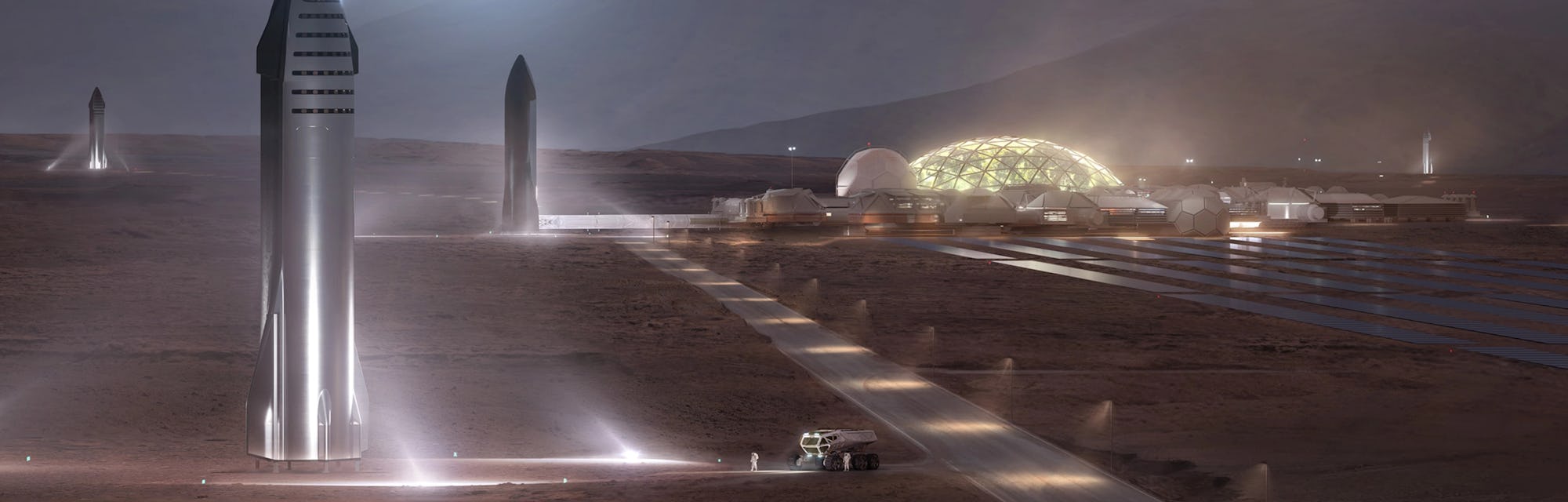
READY TO LIVE on Mars? It may not happen for a while, as Elon Musk recently revealed that astronauts on the red planet could finally become reality by 2029.
The SpaceX CEO has a long-standing vision of establishing a city on the Red Planet. It would be self-sustaining, would be home to one million people, and would transform humanity into a multi-planet species. It is perhaps Musk’s most ambitious goal, one that could keep him occupied for the next three decades.
"Why are we doing this?" Musk said at the company's February 2022 Starship progress update. "I think this is an incredibly important thing for the future of life itself ... there's always some chance that something could go wrong on Earth. Dinosaurs are not around anymore!"
Musk also explained how, being a simple insurance policy, the plan is aimed at building something inspiring.
"Life can't just be about solving problems," Musk said. "There have to be things that inspire you, that move your heart. When you wake up in the morning, you're excited about the future."
But while fans originally expected to see the first humans reach March by the mid-2020s, Musk revealed on his Twitter page this week that an image with astronauts on the red planet would more likely come to life sometime in 2029.
And as recent research shows, the landscape of Mars is pretty treacherous. Astronauts will face surprise obstacles like dust collecting on solar panels, as well as tiny Mars rocks that have caused havoc with NASA’s Curiosity mission.
Want to find out more about Musk’s plans for a Mars city? Subscribe to MUSK READS+ for exclusive interviews and analysis about spaceflight, electric cars, and more.
Here is what you need to know about Musk’s mission.
WHAT IS THE MARS CITY?
Musk plans to build a full-size city on the surface of Mars. This would be a city open to regular people, not just scientists and researchers.
People interested in moving to Mars could pay for their flight with a loan. Once there, people would be able to pay off the loan by working in anything from iron foundries to pizzerias. Musk declared at a 2016 conference that there would be labor shortages for a long time.
This city would be free to govern itself on its own terms, as indicated by the Starlink internet service terms and conditions released in October 2020. This appears to stand in contradiction to the 1967 Outer Space Treaty, which states that the launch origin country is responsible for subsequent space activities. David Anderman, who served as SpaceX’s general counsel when the terms were released, suggested to Inverse in 2021 that the two documents may be set on a collision course.
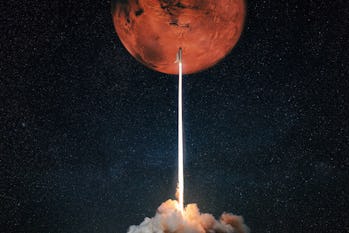
Musk estimated in 2019 that it would take around one million tons of cargo to build a self-sustaining city on Mars. Assuming it costs $100,000 per ton to send cargo to Mars with the upcoming Starship, that would put a Mars city’s price at around $100 billion. At the high end, Musk estimates it could cost around $10 trillion.
SpaceX may not stop with just one city, however. Paul Wooster, principal Mars development engineer for SpaceX, said at the 21st Annual International Mars Society Convention in August 2022 that SpaceX could build multiple cities:
“The idea would be to expand out, start off not just with an outpost, but grow into a larger base, not just like there are in Antarctica, but really a village, a town, growing into a city and then multiple cities on Mars."
WHY DOES ELON MUSK WANT TO BUILD A CITY ON MARS?
Musk’s stated aim is to transform humanity into a multi-planet species.
Over the years, he has listed reasons as to why humanity would want to expand into the universe. One theme he regularly lists is that a life-ending event on Earth could spell the end of humanity — but humanity could live on if it’s able to set up base on a new planet like Mars.
“Earth is ~4.5B years old, but life is still not multiplanetary and it is extremely uncertain how much time is left to become so,” Musk wrote on Twitter in November 2021. Beyond very worst-case scenario climate change, a surprise meteor strike could also wipe out humanity.
Another reason, as he suggested in September 2018, is because it’s a reason to keep on living:
“There’s so many things that make people sad or depressed about the future, but I think becoming a space-faring civilization is one of those things that makes you excited about the future.”
In February 2022, Musk also declared that a reason for humanity to expand is because we are “life’s guardians...the creatures that we love cannot build spaceships, but we can, and we can bring them with us.”
During an April 2021 appearance covered by CNBC, Musk indicated that another reason to go back was because humanity had barely ventured into space since the lunar landings:
“It's been now almost half a century since humans were last on the moon. That's too long, we need to get back there and have a permanent base on the moon — again, like a big permanently occupied base on the moon. And then build a city on Mars to become a spacefaring civilization, a multi-planet species.”
Musk isn’t the first person to call for humanity to colonize another planet — professor Stephen Hawking said in 2017 that humans would need to expand out within 100 years if they hoped to survive. However, astrophysicist Martin Rees said in response to Hawking and Musk that the idea was a “dangerous delusion [...] dealing with climate change on Earth is a doddle compared to making Mars habitable.”
WHEN DID MUSK FIRST GET THE IDEA FOR A MARS CITY?
It’s hard to say when he first got this idea — Ashlee Vance’s 2015 biography claims that “by the middle of his teenage years” he’d come to see “man’s fate in the universe” as his “personal obligation.” He was inspired by science fiction novels like Douglas Adams’ Hitchhiker’s Guide to the Galaxy.
The book also cites Terency Beney, who went to school with Musk. Beney claims that Musk was already thinking about colonizing other planets in his early years.
In 2001, Musk attended a meeting of the non-profit Mars Society group. During the event, Musk learned about the group’s plans to send mice into space to inspire people. Musk started considering the prospect of sending them to Mars instead, an idea that eventually led to him founding SpaceX.
In 2007, before SpaceX had even launched its first rocket to orbit, Musk told Wired that in 30 years there would be a base on the Moon and Mars.
The idea took on new form in 2016, when he gave a speech at the International Astronautical Congress about his idea to make humanity into a multi-planet species.
HOW WILL ELON MUSK BUILD A CITY ON MARS?
Central to the plan is the Starship. This fully-reusable rocket, currently under development in Texas, will enable SpaceX to send humans and cargo to Mars. The ship will be capable of launching over 100 tons or 100 people into space at a time.
Its use of liquid oxygen and methane as fuel, rather than the rocket propellant used in the Falcon 9, means explorers can fly to Mars, refuel using resources found on the planet, and fly back to Earth. The astronauts could even venture out further into space, building a planet-hopping network of refueling stations along the way.
The ship is expected to host its first flight sometime this year. While the company’s primary goal is to fly the ship from the Starbase facility in Texas, Musk has indicated that the team is also preparing to launch from Cape Canaveral in Florida should too many delays arise. This backup plan may have led to a delay to a planned expansion to Starbase.
In November 2018, Neil deGrasse Tyson declared that "a whole category of war has the potential of evaporating entirely" with planet-hopping technology. That's because humans would have the ability to venture out further and mine resources from even further away.
"In space, you have no need to fight a war, just go to another asteroid and get your resources," deGrasse said.
It’s not going to be easy. In November 2018, Musk likened the ads for going to Mars to the ads for Sir Ernest Shackleton’s expedition to the Antarctic:
“Men wanted for Hazardous Journey. Small wages, bitter cold, long months of complete darkness, constant danger, safe return doubtful. Honor and recognition in case of success.”
Although the ads probably never existed, recent expeditions to Mars have revealed Musk may be correct about the dangers from the planet.
In December 2021, the Hope mission to Mars hosted by the United Arab Emirates encountered a dust storm. It quickly advanced the thousands of miles wide, passing over the crater containing NASA’s Perseverance rover and Ingenuity helicopter. The storm lasted until January 14.
The events showed how the weather on Mars can be surprisingly brutal, especially in comparison to the weather on Earth. Dust storms that blow over solar panels can render them less effective, depriving a space station of vital electricity.
Dust isn’t the only obstacle the astronauts will face. In April 2022, NASA revealed that the Curiosity rover had to give up its ongoing expedition route due to ventifacts — sharp rocks that could damage the rover’s wheels.
Perhaps rather aptly, the mountain Curiosity was trying to climb is called Mount Sharp.
DOES JEFF BEZOS AGREE WITH ELON MUSK’S MARS CITY IDEA?
Not everybody in the space industry agrees with Musk’s vision. Jeff Bezos, founder of rival firm Blue Origin, prefers to build giant orbiting cities near Earth to expand humanity.
In May 2019, Bezos cited research from physicist Gerard K. O’Neill. He asked a key question: is a planetary surface the best place for humans to expand into the solar system? O’Neill decided the answer was no for three key reasons:
- The planetary surfaces aren’t that big. Humans would maybe, at best, double the amount of available land surface.
- They’re a long way away. A round trip to Mars would take years — the Earth and Mars align once every 22 months, and the trip itself would take a few months depending on the rocket.
- There won’t be any real-time communications with Earth because of the distance. It takes around 20 minutes to send a signal to Mars, much slower than the tens of milliseconds it takes to communicate over the internet.
Instead, Bezos prefers to build O’Neill-style colonies in Earth’s orbit. This, he claims, could support up to one trillion humans.

Musk responded to Bezos’ vision later that mont
“Makes no sense. In order to grow the colony, you’d have to transport vast amounts of mass from planets/moons/asteroids. Would be like trying to build the USA in the middle of the Atlantic Ocean!”WHAT IS THE DESIGN FOR THE MARS CITY?


Comments
Post a Comment